The Hardware Convergence: Desktop Components vs. Custom SoCs
Historically, building a gaming console meant designing bespoke hardware that bore little resemblance to consumer PCs. Today, the lines have blurred. Modern consoles are essentially highly specialized developer desktop environments packed into a confined thermal footprint.
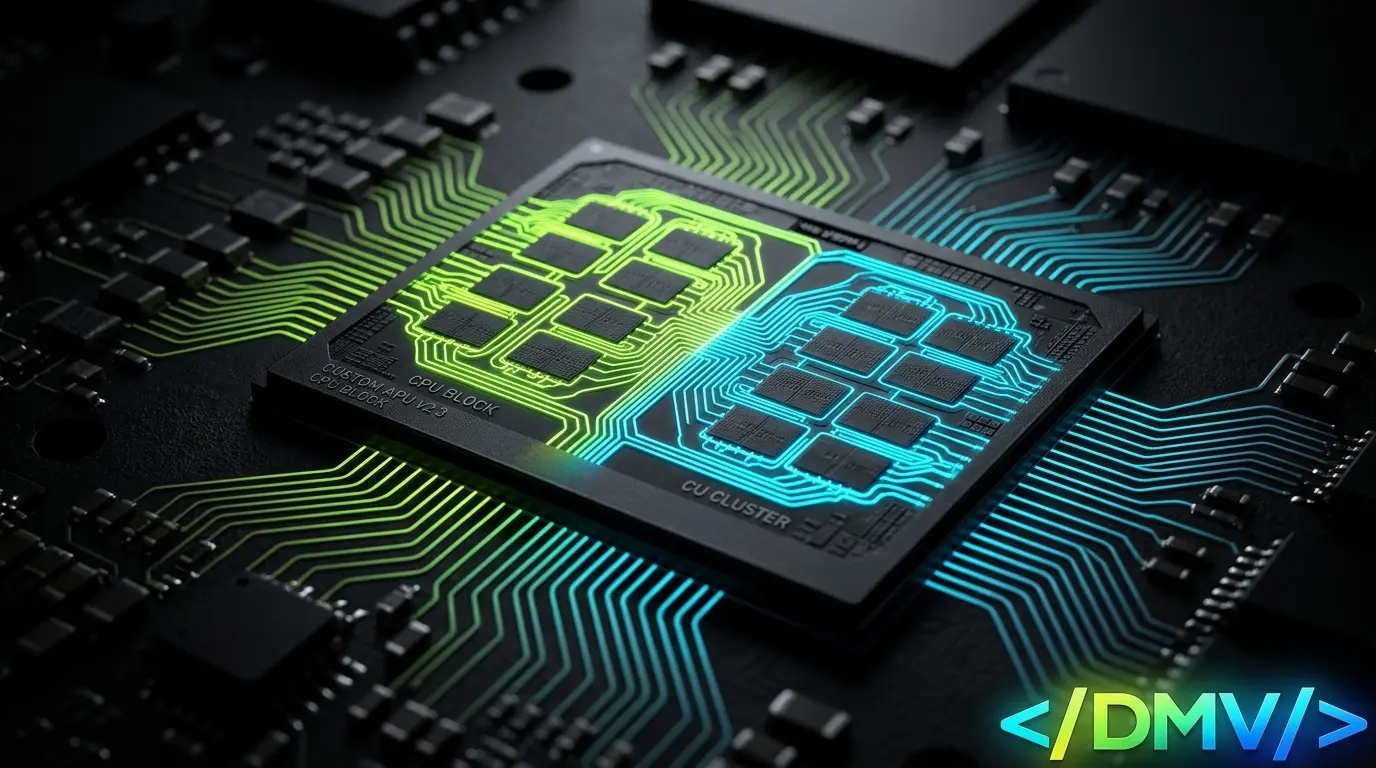
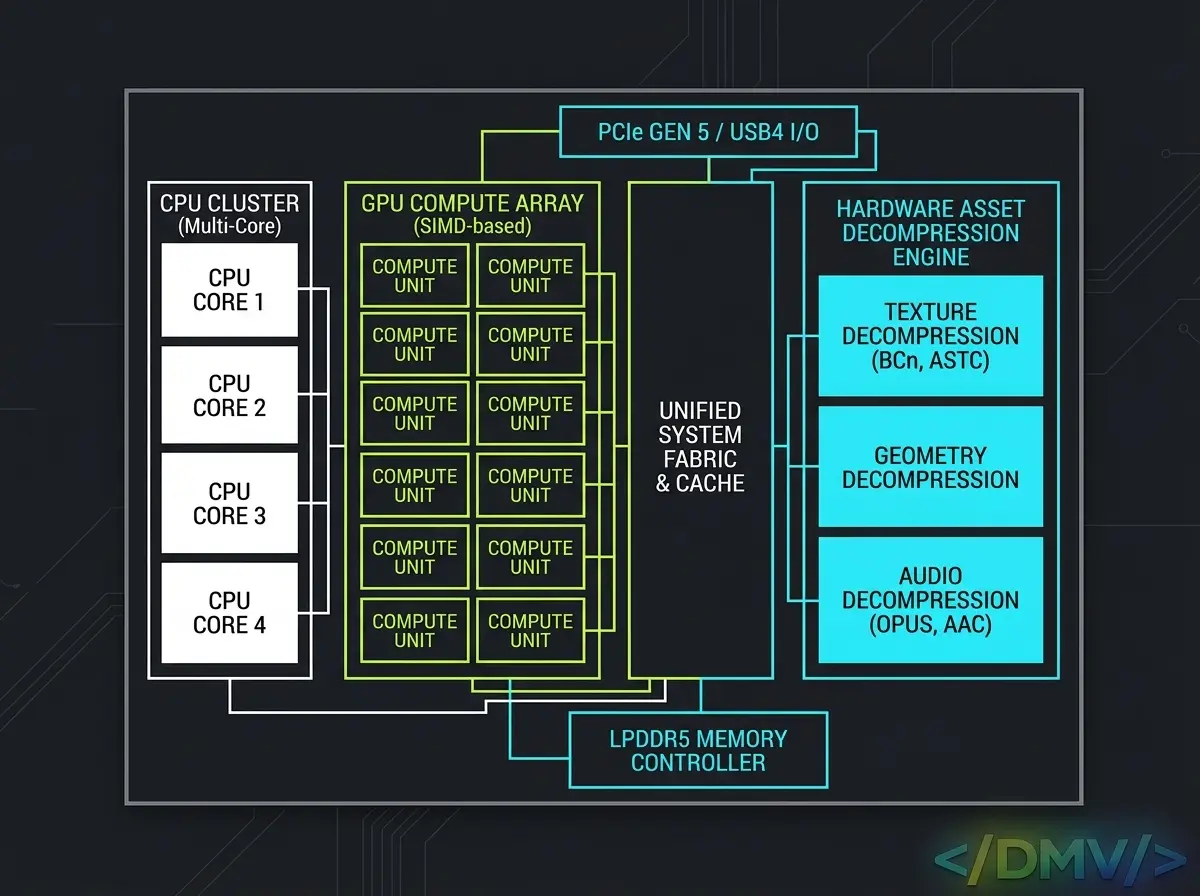
In a traditional high-end PC, the CPU and GPU are physically separated on the motherboard. Data must travel back and forth across a PCIe bus, and assets must be duplicated in both the system RAM and the GPU’s VRAM. The current console hardware APU architecture evolution solves this latency problem by integrating all processing power compute cores, graphics units, and memory controllers onto one unified piece of silicon known as an Accelerated Processing Unit (APU).
Executing the Pipeline: Inside the Console APU
To understand how these machines handle next-generation rendering, we must break down the specific silicon blocks that manage heavy asset pipelines.
The Power of Unified Memory Sub-Systems
The backbone of modern console performance is its Unified Memory Architecture (UMA). Instead of splitting memory into DDR5 for the system and GDDR6 for graphics, the console utilizes a massive, single pool of high-speed GDDR6 memory.
Because the memory is unified, when the SSD loads a high-resolution 4K texture, both the CPU and the GPU can access that exact memory address simultaneously. There is zero time wasted copying data from system RAM over to video RAM. This architecture allows the console to process heavy computational datasets with the same efficiency as a specialized developer graphics workstation.
Custom Hardware Decompression Blocks
Modern games use exceptionally large file sizes. If a traditional CPU had to unpack gigabytes of compressed SSD data every second, it would instantly bottleneck, leaving no processing power for game logic, artificial intelligence, or physics.
To bypass this, console engineers introduced custom hardware decompression engines directly onto the SoC. These silicon blocks (such as the Kraken hardware decoder) intercept compressed data streaming from the NVMe SSD and decompress it on the fly, instantly feeding raw assets into the unified memory pool without consuming a single CPU cycle.
Dedicated Ray-Tracing Hardware Accelerators
Ray-tracing simulates realistic lighting by calculating how individual light rays bounce off objects. Doing this via software requires immense computational power. To maintain fluid frame rates, the console hardware APU architecture evolution includes dedicated intersection engines built directly into the GPU Compute Units (CUs).
These fixed-function hardware accelerators offload Bounding Volume Hierarchy (BVH) traversal the heavy math required to track light paths from the main shader cores. This ensures the console can deliver cinematic lighting without compromising raw rendering performance.
Frequently Asked Questions
What is unified memory architecture in modern consoles?
Unified memory architecture means the system CPU and GPU share a single high-speed pool of RAM (such as GDDR6) over a massive bus width. This eliminates the latency caused by copying asset data across separate system and video memory pools.
How does the console hardware APU architecture evolution improve loading times?
By integrating custom hardware decompression engines and high-speed NVMe SSDs directly into the APU's input/output pipeline, consoles can stream gigabytes of asset data instantly without overwhelming the primary CPU cores.
What is a System-on-Chip (SoC) in a gaming console?
An SoC integrates all primary computing components including the CPU, GPU, memory controllers, and security processors onto a single silicon die. This reduces the physical distance data must travel, significantly lowering latency and power consumption.
Why do modern consoles use GDDR6 for system memory instead of DDR5?
GDDR6 provides significantly higher memory bandwidth, which is critical for feeding the GPU's demand for high-resolution 4K textures and assets. While traditional desktop CPUs prefer the lower latency of DDR RAM, console architecture prioritizes the massive graphical throughput required for modern rendering.
How does console ray-tracing differ from desktop PC graphics?
While the underlying mathematical principles are identical, the console hardware APU architecture evolution relies on highly customized, fixed-function ray-tracing accelerators embedded directly into the compute units to maintain consistent frame rates within strict thermal and power limits.
The Future of Hardware Engineering
The modern console hardware APU architecture evolution is a masterclass in efficiency. By eliminating the PCIe bottleneck, implementing unified memory, and utilizing custom silicon for decompression and ray-tracing, these systems punch far above their raw teraflop counts. For engineers and developers, studying this architecture provides a fascinating glimpse into the future of unified computing, where the lines between CPU and GPU become entirely seamless.
